

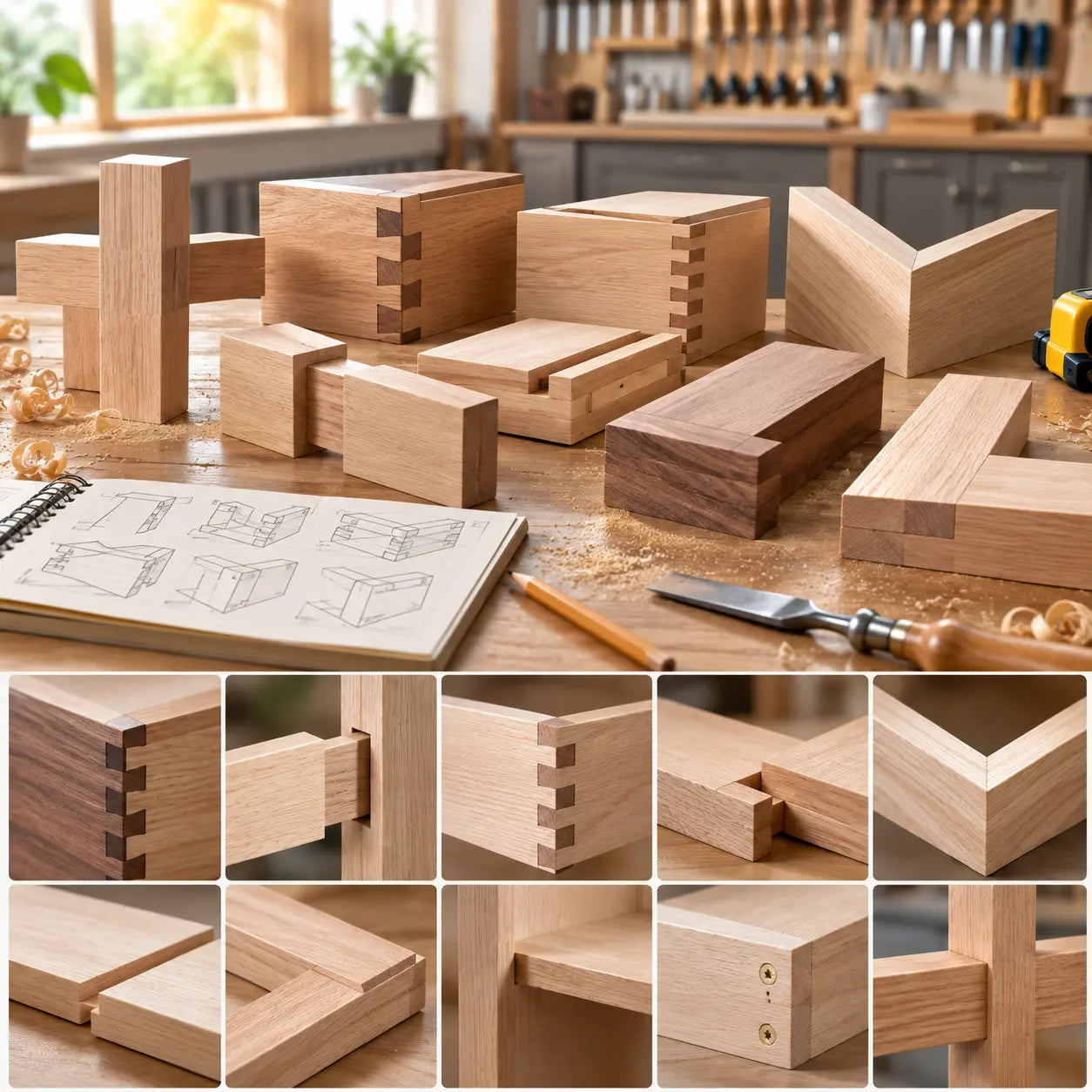
Table of Contents
- Introduction
- 1. Butt Joint
- 2. Pocket Hole Joint
- 3. Dowel Joint
- 4. Biscuit Joint
- 5. Rabbet Joint
- 6. Dado Joint
- 7. Mortise and Tenon Joint
- 8. Dovetail Joint
- 9. Box Joint (Finger Joint)
- 10. Half-Lap Joint
- Expert Tips
- Common Mistakes
- FAQ
- Conclusion
Introduction
Woodworking joints are the backbone of every project you'll ever build. Whether you're assembling a simple bookshelf or crafting a fine piece of furniture, the joints you choose determine the strength, appearance, and longevity of your work. Understanding the most common woodworking joints — and knowing when to use each one — is a fundamental skill that separates confident woodworkers from frustrated beginners.
In this guide, we'll cover the 10 essential woodworking joints you need to know, from the simplest butt joint to the elegant dovetail. For each joint, we'll explain how it works, when to use it, and how strong it is. By the end, you'll have a solid foundation for making smart joinery decisions on every project.
1. Butt Joint
The butt joint is the simplest of all woodworking joints. Two pieces of wood are simply butted together at their ends or edges and fastened with screws, nails, or glue. While it's the easiest joint to make, it's also the weakest because it relies entirely on the fasteners for strength — end grain glue joints have very little holding power.
Best for: Rough construction, shop furniture, carcass backs, and anywhere appearance and maximum strength aren't critical.
Strength: Low. Always reinforce with screws or nails.
2. Pocket Hole Joint
The pocket hole joint has revolutionized DIY woodworking. Using a pocket hole jig, you drill an angled hole into one piece of wood and drive a special screw through it into the mating piece. The result is a fast, strong joint that requires no clamps and minimal skill.
Best for: Face frames, cabinet boxes, furniture assembly, and any project where speed matters.
Strength: Good to excellent, especially in shear. Not ideal for joints under tension.
3. Dowel Joint
Dowel joints use cylindrical wooden pegs (dowels) inserted into matching holes in both mating pieces. When glued, dowels dramatically increase the glue surface area and help align parts perfectly. A doweling jig ensures accurate hole placement.
Best for: Edge-to-edge glue-ups, face frames, and furniture assembly where you want a clean look with no visible fasteners.
Strength: Good. Stronger than a plain butt joint but requires precise hole alignment.
4. Biscuit Joint
Biscuit joints use football-shaped compressed wood wafers (biscuits) glued into matching slots cut by a biscuit joiner. The biscuits swell when they contact the glue, creating a tight, aligned joint. Biscuits are primarily alignment aids rather than structural reinforcements.
Best for: Aligning panels during glue-ups, joining tabletops, and assembling cabinet carcasses.
Strength: Moderate. Excellent for alignment; adds some strength to edge joints.
5. Rabbet Joint
A rabbet is an L-shaped recess cut along the edge or end of a board. When two rabbeted pieces meet, they interlock slightly, creating more glue surface and better alignment than a plain butt joint. Rabbets are commonly used for cabinet backs and drawer bottoms.
Best for: Cabinet backs, drawer construction, picture frames, and box making.
Strength: Good. Significantly stronger than a butt joint due to the mechanical interlock.
6. Dado Joint
A dado is a channel cut across the grain of a board. A shelf or panel slides into the dado, creating a strong, self-supporting joint. Dados are the standard method for installing fixed shelves in bookcases and cabinets.
Best for: Bookshelves, cabinet shelving, drawer bottoms, and any application where a panel needs to be captured in a groove.
Strength: Excellent for supporting loads perpendicular to the joint.
7. Mortise and Tenon Joint
The mortise and tenon is one of the oldest and strongest woodworking joints in existence. A tenon (a projecting tongue) on one piece fits into a mortise (a rectangular hole) in the other. When glued, this joint is incredibly strong and resistant to racking forces — it's the joint of choice for chair legs, table bases, and door frames.
Best for: Chair and table legs, door frames, bed frames, and any structural joint that must resist racking.
Strength: Excellent. One of the strongest joints in woodworking.
8. Dovetail Joint
The dovetail joint is the hallmark of fine craftsmanship. Its interlocking fan-shaped tails and pins create a joint that is virtually impossible to pull apart. Dovetails are used for drawer boxes, blanket chests, and fine furniture — and they look stunning when done well.
Best for: Drawer boxes, jewelry boxes, blanket chests, and any application where you want to showcase your skill.
Strength: Outstanding. Mechanically locks in one direction and is extremely strong in all others.
9. Box Joint (Finger Joint)
The box joint, also called a finger joint, consists of interlocking rectangular fingers cut into the ends of two boards. It's essentially a simplified dovetail — easier to cut with a table saw jig, but nearly as strong. Box joints are popular for boxes, drawers, and decorative applications.
Best for: Boxes, drawers, small cabinets, and decorative joinery.
Strength: Very good. The large glue surface area makes this a strong joint.
10. Half-Lap Joint
In a half-lap joint, half the thickness is removed from each mating piece so they fit together flush. The result is a flat, strong joint with a large glue surface. Half-laps are commonly used for frame construction, workbench bases, and anywhere two pieces need to cross or meet at a corner.
Best for: Frame construction, workbench bases, trellis work, and corner joints in frames.
Strength: Good to excellent, depending on orientation and glue quality.
Expert Tips
- Always dry-fit your joints before applying glue. Surprises during glue-up are never welcome.
- Sharp tools make better joints. A sharp chisel cuts cleanly; a dull one tears and crushes wood fibers.
- Fit is everything. A joint that's too loose will be weak; one that's too tight can split the wood when assembled.
- Use the right glue for the job. PVA (yellow glue) is ideal for most interior joints; epoxy works well for difficult-to-glue species.
Common Mistakes to Avoid
- Rushing the fit: Take time to sneak up on a perfect fit rather than forcing a joint together.
- Skipping the dry fit: Always assemble without glue first to check fit and plan your clamping strategy.
- Ignoring grain direction: Wood moves with changes in humidity. Design joints that accommodate wood movement to prevent cracking.
- Using dull tools: Dull chisels and saw blades produce ragged, inaccurate joints. Keep your tools sharp.
Pro Tips
- Practice new joints in scrap wood before committing to your project material.
- Label all parts with chalk or pencil before disassembly so you can reassemble in the correct orientation.
- For glue-ups with many joints, use a slow-setting glue to give yourself more working time.
- A well-fitted joint needs very little clamping pressure. If you're cranking the clamps, the fit needs work.
FAQ
What is the strongest woodworking joint?
The mortise and tenon joint is widely considered the strongest traditional woodworking joint, particularly for resisting racking forces. The dovetail joint is also extremely strong and has the added benefit of mechanical locking.
What woodworking joint should a beginner start with?
Start with the pocket hole joint. It's fast, forgiving, and produces strong results with minimal tools and skill. Once you're comfortable, progress to rabbet and dado joints, then tackle mortise and tenon and dovetails.
Do I need special tools to cut woodworking joints?
Basic joints like butt joints and pocket holes require minimal tools. More advanced joints like dovetails and mortise and tenons require chisels, saws, and sometimes a router or dedicated jig. Start simple and build your tool collection as your skills grow.
Is wood glue stronger than screws in a joint?
In most cases, a properly glued wood joint is stronger than the wood itself — the glue line rarely fails before the wood does. Screws add mechanical strength but are most valuable during assembly while the glue cures.
Conclusion
Mastering woodworking joints takes time and practice, but the payoff is enormous. Each joint you learn opens up new project possibilities and gives you more confidence at the bench. Start with the simpler joints, build your skills progressively, and don't be afraid to practice on scrap wood before tackling your real project.
Looking for precision tools to help you cut perfect joints every time? Explore Fivalo's woodworking tool collection — from corner clamps to measuring and layout tools, we have everything you need to take your joinery to the next level.
Share:
Must-Know Secrets for Perfect Wood Joinery
How to Drill Concealed Hinge Holes: Setback, Depth & Test Fitting